

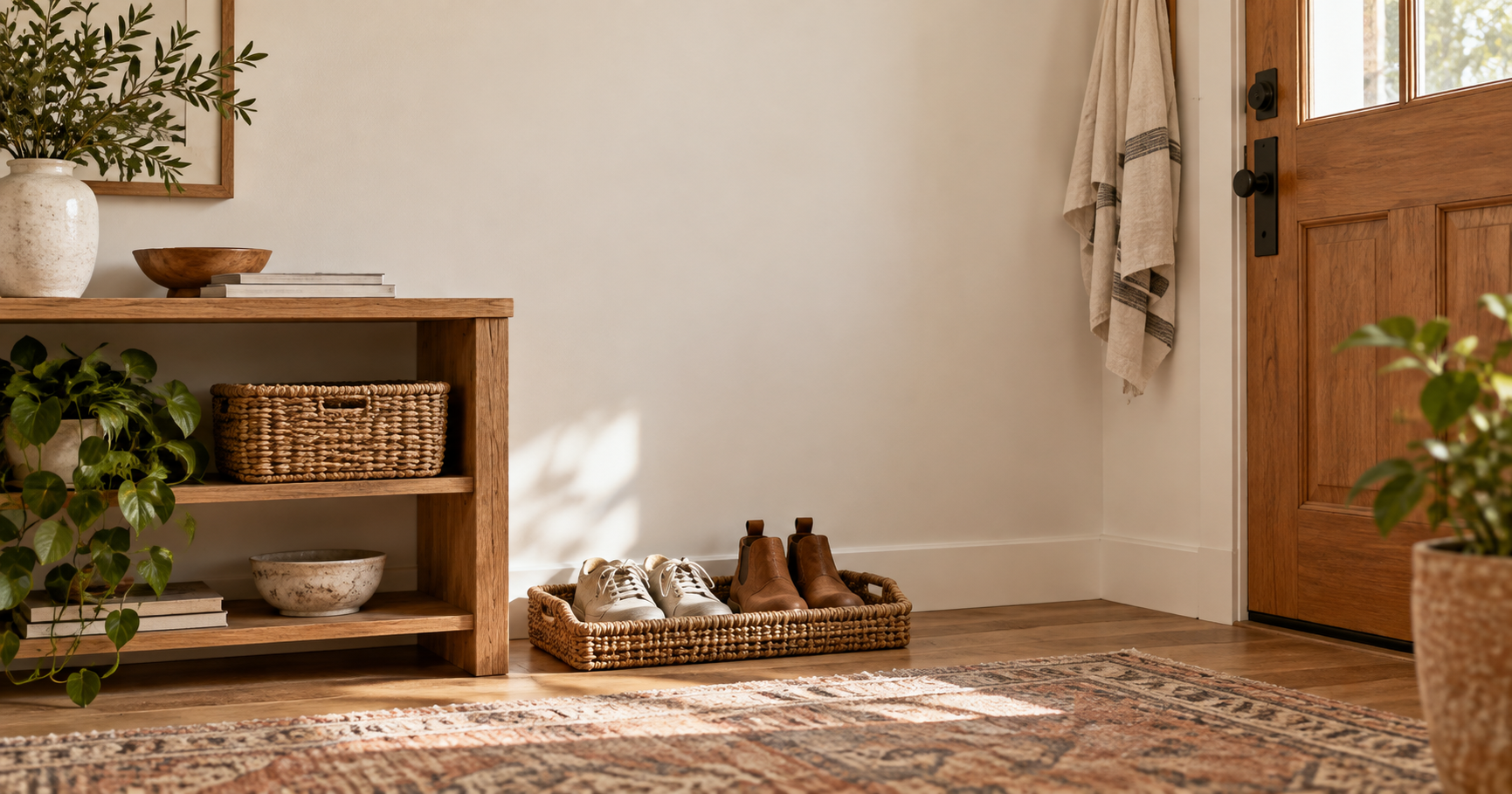
Before you buy another rack, cabinet, or basket, look at the storage already within a few steps of your front door. Entryway shoe storage ideas without buying anything are not about making the space look perfectly styled. They are about giving the pairs you actually wear a clear landing spot, with as little friction as possible.
The useful test is simple: choose one thing you already own, put it where shoes already land, and live with it for a week. If it holds the daily pairs without spilling into the walkway, you have learned something valuable. If it does not, you will know exactly what a future storage purchase needs to solve.
Start with the shoes that are actually in rotation
Do not try to store every pair you own at the front door. Pull out only the pairs worn in a normal week. Seasonal boots, occasion shoes, and the pair waiting to be cleaned belong elsewhere. The entryway needs a landing zone, not your whole shoe collection.
A shallow tray that already fits the floor
A serving tray, boot tray, low crate lid, or sturdy shallow bin can create a visible boundary for two to four everyday pairs. It works best when the tray is slightly smaller than the space you are tempted to fill; that limit is what keeps a landing zone from becoming a pile.
What it solves
- Keeps the door area readable and makes the shoe limit obvious.
Watch for
- Choose something easy to wipe down. A fabric tray is not ideal for wet shoes.
Skip it when you need to stack shoes or the tray would sit in the door swing.
One open basket for the pairs that leave every day
A spare basket can work when shoes are usually slipped on and off quickly. Place it beside the door rather than under a console table you have to bend around. One basket is enough for a small household’s daily rotation; several baskets usually become a way to avoid deciding what belongs there.
What it solves
- Hides visual clutter while keeping the routine fast.
Watch for
- A deep basket can bury one shoe under another. Keep it for soft shoes or a small number of pairs.
Skip it when the basket becomes too heavy or you cannot see what is inside.
The bottom shelf you are not using
Look at a nearby bookcase, console, or open sideboard. The lowest shelf is often the most practical shoe storage in the room because it is already close to the entrance and needs no new footprint. Give it one category only: daily shoes, not bags, mail, and shoes together.
What it solves
- Uses vertical space that already exists.
Watch for
- Leave enough clearance to slide shoes in without scraping the shelf above.
Skip it when the shelf is in a different room or requires moving decorative objects every day.
A spare drawer with a defined job
If there is a low drawer in a console or cabinet near the entrance, make it the place for small, clean shoes that otherwise drift around: flats, sandals, slippers, or children’s pairs. A drawer works when it is assigned by person or category, not when everyone tosses every shoe into it.
What it solves
- Keeps the entry visually quiet without adding furniture.
Watch for
- Check the drawer depth before committing; some drawers are better for accessories than footwear.
Skip it when you would have to remove useful household items to make room.
A sturdy tote used as off-duty storage
An empty tote bag or lidded storage bin is better used one step away from the door than directly in the landing zone. Put the shoes that are not in the weekly rotation there, then move the tote to a closet, a lower shelf, or under a bench you already own.
What it solves
- Stops rarely worn shoes from crowding out the daily pairs.
Watch for
- Label it by season or person so it does not turn into an unsorted catch-all.
Skip it when you need frequent access to every pair inside it.
The space under an existing bench or chair
If you already have a bench, chair, or narrow console near the entrance, use the clear floor under it before adding a separate rack. A low tray, two pairs lined side by side, or a shallow basket can make the area intentional without changing the room.
What it solves
- Keeps storage visually connected to a piece already serving the entryway.
Watch for
- Leave enough room for feet and do not turn the area into hidden overflow.
Skip it when the furniture is too low for shoes to slide under easily.
A small shelf moved closer to the behavior
A shelf does not need to be marketed as shoe storage to do the job. An unused wall shelf, plant stand, or small open unit can work if it is stable and shallow enough for the route. The important move is relocation: storage placed where shoes already come off beats a nicer unit placed somewhere inconvenient.
What it solves
- Turns an existing object into a low-friction landing spot.
Watch for
- Keep the walking path clear and secure anything that could tip.
Skip it when it blocks the entry or needs a risky installation change.
A spare hook or bag for lightweight pairs
For slippers, foldable flats, or children’s shoes, a sturdy tote on an existing hook can keep the floor clear. This is not a solution for heavy boots or a whole family’s shoes. It is a small category solution for pairs that otherwise disappear under furniture.
What it solves
- Frees floor space for the shoes that need it most.
Watch for
- Keep the bag low enough to use easily and away from a door that swings into it.
Skip it when you need a solution for structured shoes or anything wet and dirty.
A temporary marked zone before you reorganize
If no container works yet, use painter’s tape, a small mat, or a folded towel as a one-week test. The point is not the material; it is learning the real footprint, shoe count, and route before you buy. A temporary zone is often more honest than a polished organizer chosen too early.
What it solves
- Shows whether the proposed location works before money is spent.
Watch for
- Treat it as a test, not a permanent answer if it creates a trip hazard or gets damp.
Skip it when the entrance is too busy for an open floor zone.
How to tell whether your reuse-first setup is enough
Keep it if three things are true: shoes fit without blocking the walkway, everyone using the door can follow the system without being reminded, and the zone stays within its intended number of pairs for a week. If one of those fails, do not jump straight to a bigger organizer. First identify the failure: wrong location, too little capacity, no separation between daily and off-duty shoes, or too many actions to put a pair away.
When you probably do need a dedicated piece
A temporary setup has done its job if it reveals a specific problem it cannot solve: you need seated storage, closed storage for a visible entryway, a shallow cabinet for a narrow wall, or more capacity that still fits the walking route. At that point, use the measurements and routine you learned to compare a piece for the right reason, not just because it looked good in a listing photo.
If rearranging what you own still leaves a specific storage gap, compare options against the space and daily-use needs you identified in Entryway Shoe Storage for Small Spaces: A Buying Guide.